

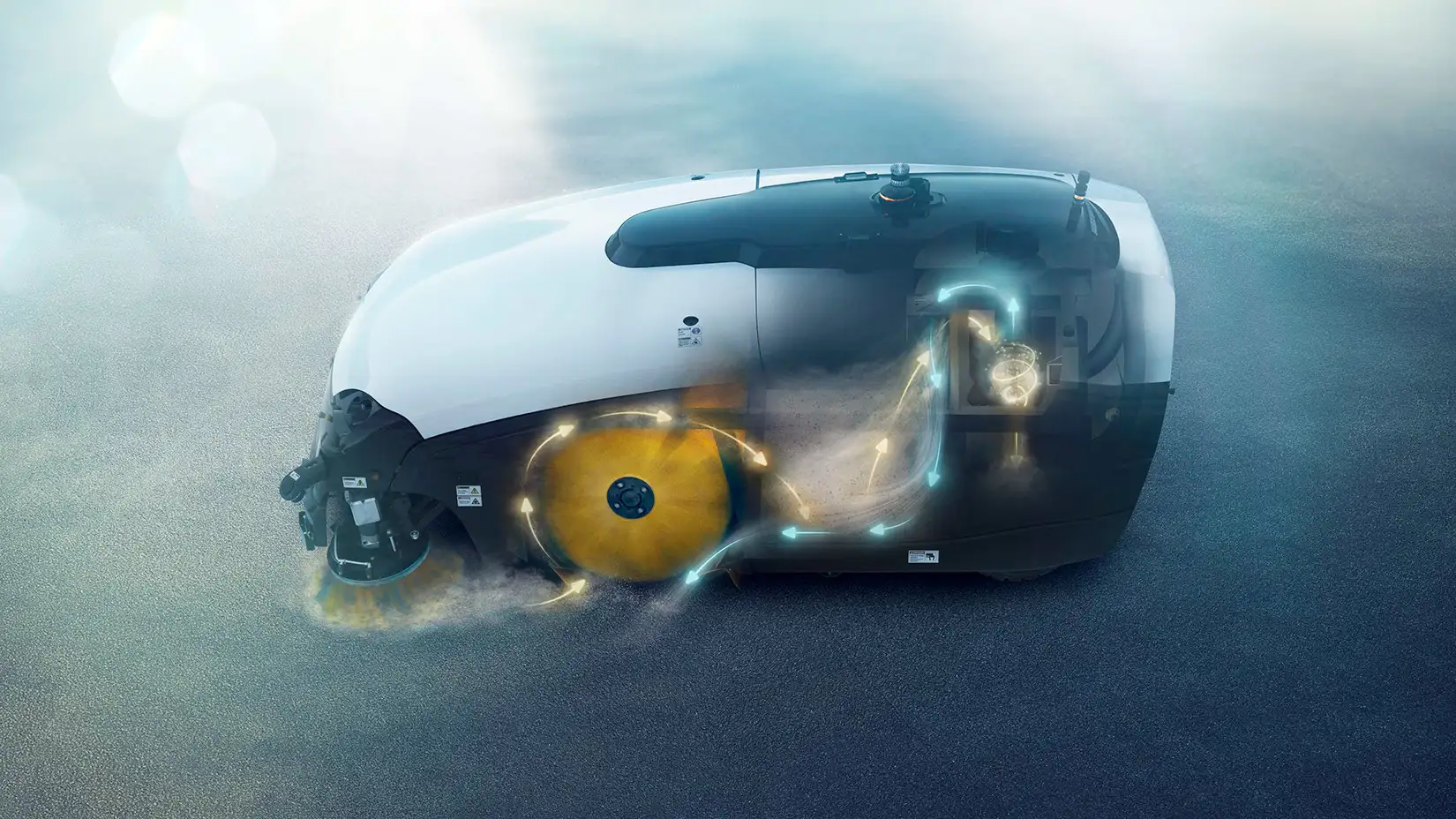
Autonomous sweepers replace repetitive manual yard cleaning by using sensors, mapping, and autonomous navigation to clean industrial and logistics sites without a driver behind the wheel. Instead of relying on someone to repeatedly sweep the same stretches of ground — through night shifts, changing weather and the daily movement of a busy yard — autonomous mobile robots can be sent out on scheduled cleaning missions, responding to the people, vehicles, and unexpected obstacles they encounter along the way. It’s autonomous yard sweeping designed around the reality that an industrial site rarely stands still.
Technology replacing labour has always raised legitimate questions about jobs, skills, and who benefits from productivity gains. But, there’s a meaningful distinction between removing the people from the work and removing repetitive work from people’s jobs. Autonomous yard sweeping offers one practical example: a machine learns to negotiate a changing world, while human time can be spent elsewhere.
Why Outdoor Sweeping Roles Are Getting Harder to Staff in Europe
Across Europe, persistent labour shortages are making routine outdoor roles increasingly difficult to staff, particularly where the work involves long night shifts, repetitive tasks, or demanding conditions. The European Labour Authority describes labour shortages as an increasingly structural problem here, influenced by demographic change, working conditions, skills mismatches, and limited labour mobility. For logistics, recycling, and industrial sites, the symptoms are familiar: vacancies that remain open, high turnover, and greater reliance on contractors to keep essential work moving.
People want time with their family and friends. They want sleep, sociable hours, and work that makes worthwhile use of their skills. Perhaps there’s something worth listening to in that. Work happens inside the daily realities of a human life, and expectations around that relationship have changed. When night-shift labour or repetitive outdoor work becomes persistently difficult to recruit for, the question is not only how to fill the vacancy, but whether the vacancy even needs to be filled by a person at all.
This is where the question of manual labour vs automation becomes more interesting. Thanks, mostly, to dystopian depictions of a world overrun by robots, technology replacing labour is often framed as a contest between human and machine. And while a healthy dose of sceptism is far from a bad thing, automation can also give us an opportunity to reconsider where human labour is considerably more valuable. An outdoor labour shortage doesn’t make yard maintenance just… disappear. Dust gathers and vehicles still move; industrial sites continue operating when most people would much rather be home. Autonomous sweeping offers another way to organise that work. Routine cleaning can continue through nights and off-peak hours without requiring a person to spend those same hours repeatedly covering the yard. The value of automation, then, is ultimately in the way it allows us all to live fuller, richer lives both inside and outside of work.
How Traditional and Semi-Automated Sweeping Falls Short
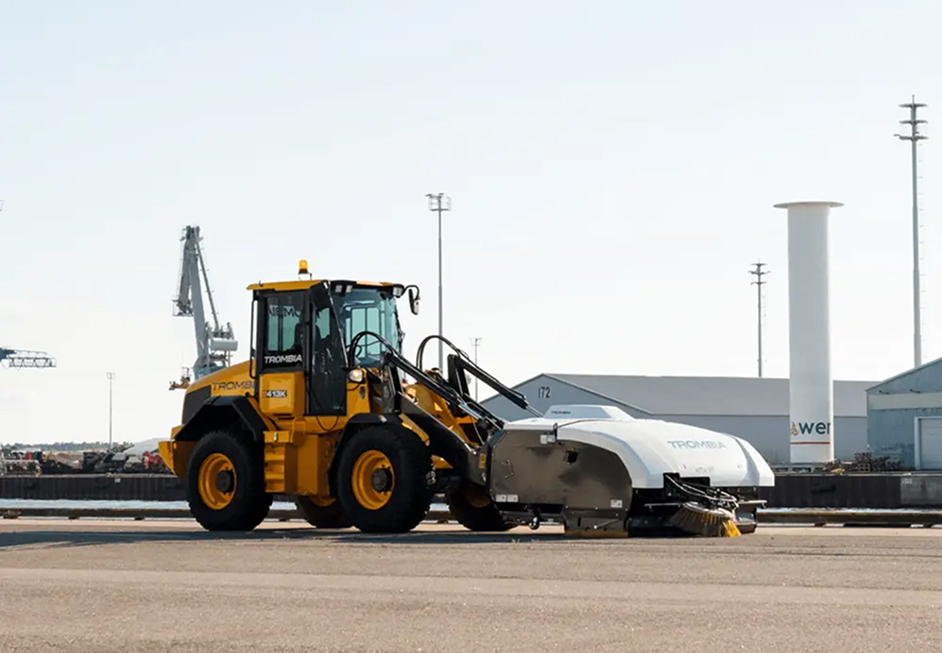
Traditional and semi-automated sweeping systems can make yard cleaning faster and less arduous for the worker at hand, but they don’t remove the need for someone to be there. A conventional street sweeper still needs a person behind the wheel. Semi-automated systems can take certain movements or functions off their hands, but someone still has to shepherd the machine through the rest of the job. Less of a demanding task, perhaps, but one that carries considerably larger consequences. Automating the mechanics of sweeping is not the same as automating the work itself. If someone still needs to arrive, climb into the cab, and trace the same paths across a yard, the familiar questions of staffing night shifts and availability remain. The machinery may have moved forward but the structure of the day hasn’t necessarily moved with it.
Contract sweeping puts another degree of separation between the site and the work, but the requirement for someone to be there and present remains. Outsourcing can offer useful flexibility, particularly when permanent roles are trickier to fill, yet contractors are drawing from the same stretched labour market. Cleaning also has to fit around another company’s timetable, even when the yard itself has other ideas: trucks arrive late, loads spill, dust gathers, and yesterday’s clean route becomes today’s problem area. This is precisely where the difference between autonomous sweepers vs manual sweeping becomes more substantial. Full autonomy changes more than the machinery collecting dust and debris as it begins to untether the task from the person who’d otherwise have to accompany it. Instead of searching for ever more efficient ways for someone to make the same, monotonous journey around a yard in sleet, snow, or some other undesirable condition, the journey itself can be handed over.
What Is an Autonomous Street Sweeper? (AMR vs AGV Explained)
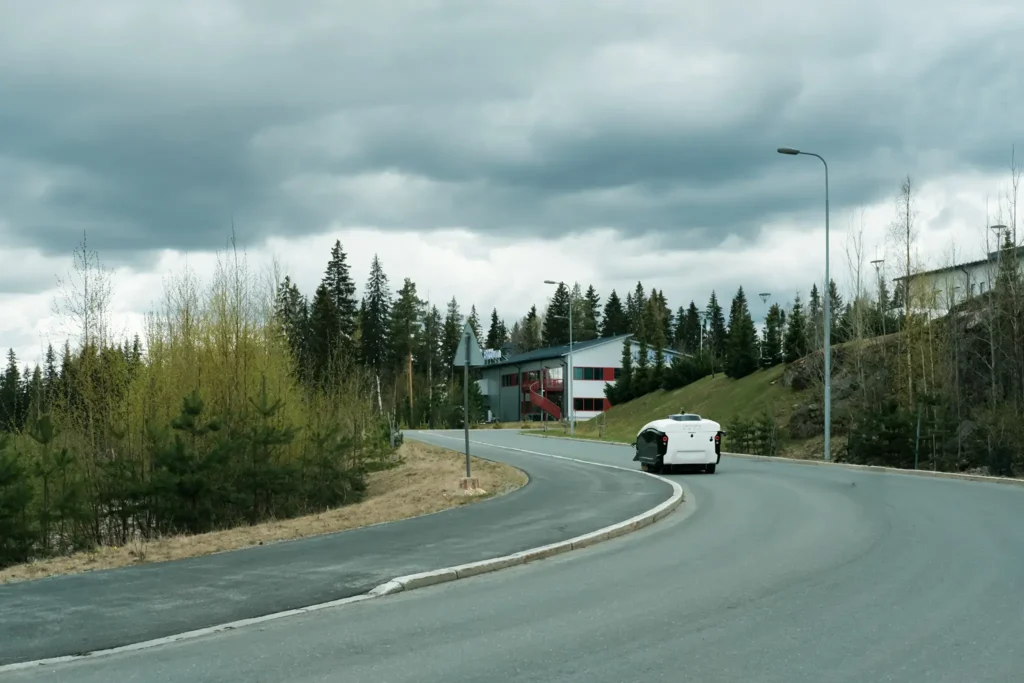
An autonomous street sweeper is a self-driving mobile machine that can carry out sweeping missions without an onboard operator, using technologies such as LiDAR, GNSS, and sensor fusion to understand its position, navigate its surroundings, and detect obstacles. In Trombia Free, these systems are combined with remote monitoring and a docking station for automatic emptying and washing, allowing the industrial cleaning robot to operate as part of a wider autonomous system.
The key word here is autonomous. An autonomous mobile robot, or AMR, does more than travel between one predetermined point to another: it perceives what is happening around it and uses that information to navigate. This is an essential consideration when weighing up the differences between AMR vs AGV. Automated guided vehicles traditionally depend on fixed or predefined routes and guidance infrastructure, while AMRs can respond more dynamically as their surroundings change.
| AMR | AGV | |
| Navigation method | Uses onboard sensors, mapping and software to navigate its environment | Traditionally follows fixed or predefined guidance and routes |
| Path flexibility | Can respond dynamically to obstacles and changes in its operating environment | Typically operates within a more constrained route |
| Typical use case | Flexible material movement, mobile robotics and autonomous tasks in changing environments | Repetitive transport along stable, predictable routes |
If you’re slightly unsure about what an AMR robot is exactly, and how it manages to find its way through a busy physical world, one answer begins with light. Through the technological assistance of a process known as LiDAR (Light Detection and Ranging), pulses of laser light are sent out and measured, building a three-dimensional picture of the surrounding environment on their return. The principle is wonderfully familiar. A bat moving through darkness sends sound into the world and listens out for the inevitable echo that returns. LiDAR performs a distant electronic cousin of that trick, only with light: sending a signal outward and learning about the terrain and distance of the world from what comes back. Trombia Free combines 3D LiDAR with GNSS satellite positioning and odometry through sensor fusion, bringing several streams of information together rather than asking any single sense to tell the entire story.
In an industrial yard, the world refuses to remain conveniently mapped, and for autonomous outdoor cleaning to be useful, a machine needs more than a memorised line to simply follow: it needs to continually locate itself and recognise when the environment around that line has changed.
Autonomy also has to be safe. ISO 3691-4 sets safety requirements and methods of verification for driverless industrial trucks and their systems, including both autonomous mobile robots and automated guided vehicles. Trombia Free meets ISO 3691-4 and uses a PLd-classified safety system, alongside ISO 13849 functional-safety requirements for control systems. Once the driver’s seat is empty, perception becomes just as important as movement. As a bat finds its way through darkness, the machine must continually read and respond to the yard around it.
Autonomous Yard Sweeping in Practice: The Jätekukko Deployment
Jätekukko Oy’s waste and recycling facility in Kuopio, Finland, serves 15 municipalities and around 215,000 residents, with the yard open seven days a week. That leaves little room for cleaning in isolation: the sweeper has to work around the same trucks, customers and unpredictable loads that create the debris in the first place.
The task: a yard in constant use
Grit, plastics, fine particles and stray debris accumulate between truck movements and public drop-offs, while tyres and heavy vehicles lift fine dust back into the air. Left unchecked, the problem travels beyond an untidy surface area. Debris can damage vehicle tyres, and airborne dust can spill out towards neighbouring suburbs; all the while, both employees and customers have to move through the yard safely.
The problem: finding an empty moment
Conventional truck sweepers are loud, water-intensive and best suited to long, open runs. At Jätekukko, the yard offers few of those. Cleaning has to be threaded between operating hours and vehicle peaks, while repeated re-entry and idling add time and disruption. Water-based dust suppression brings another complication when the inevitable Finnish winter hits.
The Trombia solution: teaching the machine the yard
Trombia Free was deployed as an autonomous mobile robot for outdoor industrial cleaning. Routes are taught once, then repeated as scheduled missions with remote monitoring rather than an operator onboard. That allows cleaning to slip into the quieter hours and overnight periods, with ad-hoc missions dispatched when debris builds up unexpectedly. Trombia Free’s dry sweeping system controls dust without continuously spraying water across the surface. After completing a mission, the sweeper can return to its station for autonomous hopper emptying and cyclone washing, readying the system for its next run with less routine human handling.
The results: cleaning little and often
Instead of waiting for the rare moment when an operator, machine, and a silent yard all coincide, the task of cleaning Jätekukko can be tended to in shorter, more frequent runs while staff remain focused on their core work. For a yard that rarely stands still, perhaps that is the more useful kind of autonomy. Gone are the days where everyone has to arrange themselves around the sweeper. Now, the sweeping can arrange itself around the site and, in most cases, everyone is all the more happier for it.
What Separates a Deployed Autonomous Sweeper From a Prototype
When evaluating an autonomous street sweeper, three essential factors help separate a commercially deployed system from something closer to a research prototype: whether autonomy is purpose-built into the machine, whether it can clean without depending on water, and whether its safety systems meet recognised industrial standards. A demonstration is useful as it proves that a machine can move and sweep all by itself. Deployment asks the harder question: can it keep doing so, safely and reliably, when the lived realities of a yard enter the equation?
1. Purpose-Built Autonomy vs Autonomy Bolted onto a Cleaner
A purpose-built autonomous sweeper is designed around driverless operation from the get-go, rather than adding sensors and autonomous controls to a machine originally built around a human driver. Navigation, obstacle detection, sweeping systems, remote supervision, and servicing all have to work together when there is nobody onboard to weather the storm when something doesn’t quite go to plan. In a working yard, where routes divert at the last-minute and obstacles arrive unannounced, autonomy needs to belong to the architecture of the machine rather than simply sit on top of it.
2. Dry Sweeping vs Water-Dependent Operation
Dry sweeping allows an autonomous sweeper to control dust without relying on the continuous water consumption used by many conventional sweeping systems. For outdoor sites, this removes another resource that has to be supplied, carried and managed during operation. In Finland, water also meets the rather immovable fact of winter. Freezing temperatures complicate water-dependent cleaning just when grit, dust and debris have hardly disappeared. A system intended to work autonomously across seasons needs its cleaning method to withstand the environment as convincingly as its navigation does.
3. Certified Safety: PLd, ISO 3691-4, ISO 13849
For a driverless machine sharing industrial space with people and vehicles, safety has to extend beyond successful obstacle detection. ISO 3691-4 specifies safety requirements and verification for driverless industrial trucks and their systems, while ISO 13849 covers the safety-related parts of machinery control systems. Trombia Free is designed to meet ISO 3691-4 requirements with a PLd safety classification under ISO 13849. But what does this mean in practice? These standards bring safety into the engineering itself on a more grounded level, addressing how safety-critical systems must perform when the machine is operating without a driver there to intervene. Ultimately, deployment will forever happen beyond controlled conditions. Rain falls, temperatures drop, people gather. A commercially viable autonomous sweeper has to survive contact with the wonderfully inconvenient reality of a working yard.
Deploying Autonomous Sweeping: What the First 90 Days Look Like
Deploying Trombia Free at a new site is infrastructure-agnostic: no lane markings, sensor installation or major facility modifications are required for the autonomous mobile robot to navigate before it arrives. Instead, deployment begins by introducing the machine to the environment straight away: defining the site, mapping its surroundings, teaching cleaning routes and connecting the system to its service and remote support infrastructure.
- Define the site. The first step is establishing where the sweeper will operate, including all boundaries and cleaning areas that make up its working environment. Rather than turning the yard upside-down to accommodate the new robot, the deployment starts with the yard as it already exists.
- Map the environment. The site’s physical environment is mapped so the autonomous system can locate itself and navigate within it. Buildings, boundaries and the wider layout become part of the machine’s working understanding of the site.
- Teach the routes. During route teaching, an operator guides Trombia Free using a radio controller and smooth operating system. Cleaning routes can then be saved and repeated autonomously as scheduled missions. It is less a matter of laying down a track than showing the machine the journeys it will later make alone.
- Set up the Service Station. The Service Station gives routine autonomous operation a home base, supporting functions such as hopper emptying and cyclone washing. This allows more of the cleaning cycle to take place without routine hands-on intervention.
- Connect remote monitoring and support. Once everything is set up and running, Trombia Free can be remotely monitored, with helpdesk support available when needed.
For workforce automation, the first months are as much about settling the technology into the fabric of a site as switching it on. Routes become repeatable missions, cleaning can move into quieter hours, and staff become supervisors of the task rather than constant companions. See how Trombia Free operates autonomously.
Autonomous Sweeping FAQ
How does an autonomous mobile robot navigate an outdoor yard without lane markings?
An autonomous mobile robot such as Trombia Free uses 3D LiDAR, GNSS, odometry and sensor fusion to locate itself and navigate the world around it without the need for painted lanes or physical guidance. Routes are taught and baked in during deployment and the machine uses its onboard sensing systems to understand its position, detect obstacles, and respond as the environment around it changes.
Can an autonomous sweeper work indoors as well as outdoors?
As with the majority of autonomous sweepers out there, Trombia Free is purpose-built for outdoor industrial environments including logistics, recycling and other large yard areas. It’s worth considering factors such as positioning, available space, surface type, and a manufacturer’s approved operating environment rather than assuming an outdoor system is suitable for every indoor facility.
What safety certifications should an autonomous sweeper hold for industrial use?
Industrial autonomous sweepers should meet safety standards appropriate to driverless machinery operating around people and vehicles. ISO 3691-4 sets safety requirements for driverless industrial trucks and their systems, while ISO 13849 covers safety-related parts of machinery control systems. Trombia Free’s safety system is designed according to ISO 3691-4 with a PLd safety classification.
How does an operator schedule and supervise an autonomous sweeper?
Remote monitoring allows operators to supervise the system without the need to remain onboard throughout each and every mission. Using a radio controller and Trombia’s built-in smooth system, operators can teach Trombia Free specific cleaning routes, before then saving those routes for scheduled autonomous missions. Cleaning can still be carried out on an ad-hoc basis when conditions require it.
Can autonomous sweeping run at night without staff on site?
Autonomous sweeping can be scheduled for night and off-peak operation without an onboard driver, making these periods particularly useful for cleaning busy industrial yards. It’s important to note, though, that whether a site can operate completely without staff present depends on its individual safety assessment, operating procedures and local requirements.
How Can I Buy or Lease a Trombia Free Autonomous Sweeping System?
Trombia Free is available through Trombia’s international dealer network, with local partners able to advise on availability, initial setup, and more. For current information on purchasing or leasing in your location, find an authorised Trombia dealer in your region.

